Beach volleyball is tied closely to popular culture, where beauty contests and beach movies brought the sport a large fan base during the 1950s and '60s. The indoor game entered the Olympics in1964 and beach volleyball was recognized in 1996.
Warning: include(/www/specials/olympics2004/mainheader.html): failed to open stream: No such file or directory in /srv/users/thaarchives/apps/thaarchives/public/specials/olympics2004/events/volleyball.php on line 2
Warning: include(): Failed opening '/www/specials/olympics2004/mainheader.html' for inclusion (include_path='.:/opt/sp/php7.4/lib/php') in /srv/users/thaarchives/apps/thaarchives/public/specials/olympics2004/events/volleyball.php on line 2
Warning: Use of undefined constant php - assumed 'php' (this will throw an Error in a future version of PHP) in /srv/users/thaarchives/apps/thaarchives/public/specials/olympics2004/events/volleyball.php on line 3
Posted on: Wednesday, August 11, 2004
VOLLEYBALL
FALIRO COASTAL OLYMPIC COMPLEX
Once called "mintonette," the game now called volleyball is today played both inside on a hard surface and outside on a sandy beach surface. Both varieties originated in the United States but quickly spread worldwide.
|
Beach volleyball is tied closely to popular culture, where beauty contests and beach movies brought the sport a large fan base during the 1950s and '60s. The indoor game entered the Olympics in1964 and beach volleyball was recognized in 1996. |
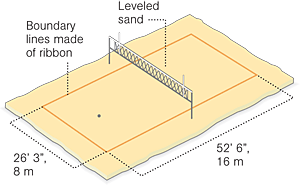
OLYMPIC BEACH VOLLEYBALL CENTER
Players — Teams of two compete against each other with no substitutions.
|
Game — Three games maximum; the first two games are played to 21 points; if the teams are tied after two games, a third is played to 15 points. A two-point lead is needed to win all games. |
|
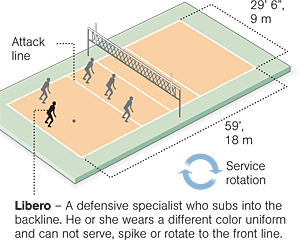
PEACE AND FRIENDSHIP STADIUM
Players — Teams of 12, with six players on the court at a time, compete against each other.
|
Game — Five sets maximum; the first four sets are played to 25 points, with the set-winner leading by two points; if the teams are tied 2-2 after four sets, a fifth is played to 15 points, with a two-point difference needed to win. |
|
The ball
 |
The ball is leather or synthetic with an inflatable inner bladder. Indoor balls may be many colors; beach balls are blue, yellow and white. Weight: 9 to 10 oz., 260 to 280 g |
Net height
 |
• Men: 7' 115/8", 2.43 m |
Sources: International Olympic Committee; Athens Olympic Committee; "Competitive Swimming Manual for Coaches and Swimmers," James E. Counsilman; "Swimming & Diving," American Red Cross; "Sports: The Complete Visual Reference," Fran'ois Fortin; International Association of Athletics Federations; Summer Games Access; Mondo spa/Mondo USA; USA Volleyball; International Volleyball Federation; "The Complete Book of the Summer Olympics," David Wallenchinsky
Warning: include(/www/specials/olympics2004/footer.html): failed to open stream: No such file or directory in /srv/users/thaarchives/apps/thaarchives/public/specials/olympics2004/events/volleyball.php on line 87
Warning: include(): Failed opening '/www/specials/olympics2004/footer.html' for inclusion (include_path='.:/opt/sp/php7.4/lib/php') in /srv/users/thaarchives/apps/thaarchives/public/specials/olympics2004/events/volleyball.php on line 87
Warning: Use of undefined constant php - assumed 'php' (this will throw an Error in a future version of PHP) in /srv/users/thaarchives/apps/thaarchives/public/specials/olympics2004/events/volleyball.php on line 88